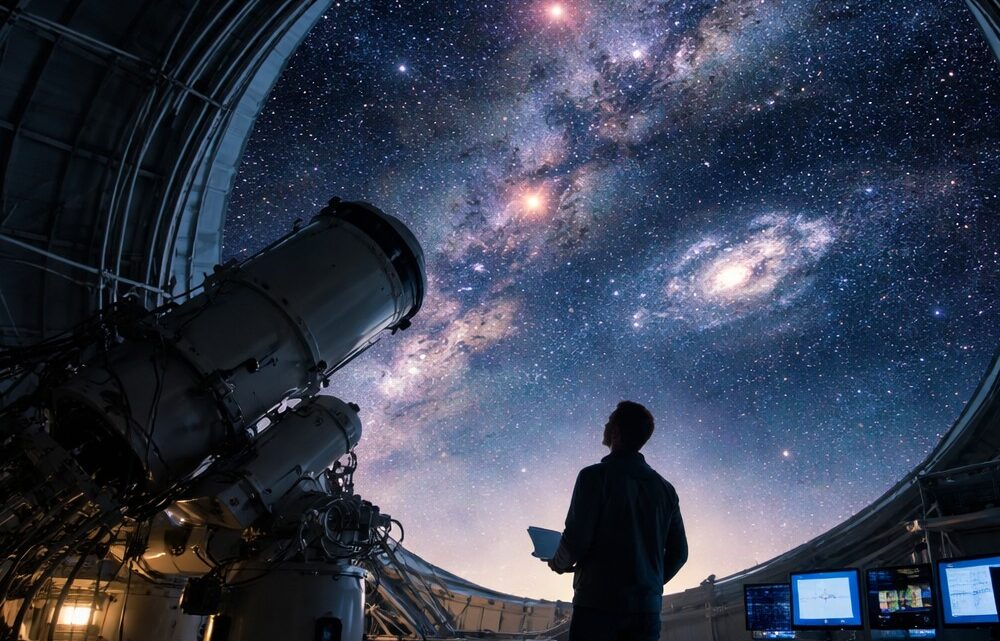
Unlocking the Mysteries of the Universe: Science’s Boldest Frontiers
Science boldly goes where few minds dare to venture. At the forefront of this exploration are not just individual discoveries, but entire fields pushing the envelope of what we know about the universe. Let’s delve into some of these bold frontiers and see what they reveal about our cosmos.
Dark Matter and Dark Energy: The Unseen Universe
When astronomers observe galaxies, something puzzling occurs. The visible matter accounts for only a small fraction of the gravitational forces at play. Enter the theories of dark matter and dark energy. Dark matter, although invisible, makes up about 27% of the universe’s mass-energy content. Scientists are using advanced instruments to detect its elusive presence. On the other hand, dark energy, constituting roughly 68%, drives the accelerated expansion of the universe. The combined pursuit of these mysteries might radically reshape our understanding of physics.
Quantum Computing: The New Age of Information
While classical computers use bits as basic units of information, quantum computers utilize qubits, which can represent and store information in complex quantum states. This significant difference allows quantum computers to solve certain problems exponentially faster. Industries ranging from cryptography to pharmaceuticals are contemplating a quantum leap in capabilities. The potential to transform problem-solving is vast, heralding a new era of computing power.
The Interstellar Lifestyle: Life Beyond Earth
Are we alone in the universe? This question spurs a vast array of research into astrobiology and the search for extraterrestrial intelligence (SETI). Advanced telescopes and space missions are designed to detect biosignatures on distant exoplanets. Scientists are focusing on planets in the “Goldilocks zone” where conditions might be just right for life. This frontier doesn’t only promise answers about life elsewhere, but it also invites introspection about life here on Earth.

Climate Science: Decoding the Planet’s Future
Understanding climate dynamics is crucial for predicting future changes to our environment. Researchers utilize satellite data and climate models to study phenomena ranging from ocean currents to carbon cycles. By predicting shifts in climate, scientists aim to mitigate future impacts. Efforts to develop sustainable technologies and practices are intertwined with this research, emphasizing the importance of actionable insights and policy-making.
CRISPR and Genetic Engineering: Editing Life
The field of genetic engineering has exploded with the advent of CRISPR-Cas9 technology, which allows for precise edits to DNA. This revolutionary tool holds potential for treating genetic disorders, improving crops, and even eradicating diseases. The ethical implications are profound, prompting global discussions on how far humanity should go in manipulating genetic material. Balancing innovation with ethical responsibility remains a challenge.
Space Exploration: Beyond the Final Frontier
The ambition to explore Mars and beyond is more pronounced than ever, with missions designed to establish a human presence on the Red Planet. Private companies and governmental space agencies are competing and collaborating in this new space race. Such endeavors aim to unravel mysteries about planetary formation and the possibility of colonization. Space exploration continues to inspire generations, pushing the boundaries of what humankind can achieve.
As we stand at the edge of these scientific frontiers, the curiosity and drive to understand our universe continue to propel us forward. The discoveries we make today will not only redefine life as we know it but will also set the stage for future inquiries and innovations. Whether through unlocking hidden aspects of our surroundings or venturing into unknown realms, the quest to illuminate the mysteries of the universe never ceases to captivate our collective imagination.